The Intentional Pause: How Small Moments Can Help You Find Greater Peace
The Intentional Pause: How Small Moments Can Help You Find Greater Peace
We often treat healing like a massive project—something we’ll finally get to when we have enough time, enough money, or a free week to disappear to a retreat. In real life, however, most of us are caring for families, answering messages, meeting deadlines, and trying to remember what we walked into the kitchen for. After decades of practicing and teaching, I’ve realized that the most meaningful changes rarely begin in those big, rare moments. They begin in the tiny, quiet gaps of everyday life. An intentional pause may last only a few seconds, but repeated moments of rest, awareness, and nervous system regulation can gradually change how you move through your day—and how your life feels from the inside.
Your brain is incredibly loyal. It pays attention to what you practice most often. If you spend your day rushing from one “fire” to the next, your mind and body become familiar with high alert. Tight shoulders, shallow breathing, impatience, and mental fog can start to feel normal. You may even begin to believe that being stressed is simply part of your personality. But when you add intentional pause moments to your routine, you practice another way of being. You move from automatically reacting to the world toward consciously choosing your next step. That choice does not have to be dramatic. Sometimes it is simply one breath before you answer, one moment of noticing before you scroll, or one quiet minute before you carry the day’s stress into your home.
Why an Intentional Pause Changes Everything
When something upsets us—a frustrated driver, a difficult email, a child melting down, or a to-do list that seems to grow while we sleep—our bodies often go on autopilot. We clench our jaws, hold our breath, grip the steering wheel, or stop feeling our feet on the ground. The reaction may happen before we have words for it. That is why telling yourself to “just calm down” is usually not very helpful. A pause works differently. It gives you a chance to notice what is happening without criticizing yourself for it.
A pause moment acts like a gentle speed bump for your nervous system. By stopping for even ten seconds, you give your body and mind a chance to catch up with each other. You might notice that you are hungry, overstimulated, sad, or simply tired. You may realize that the message you were about to send needs a kinder tone—or that it can wait until tomorrow. In that small space, you regain a little power. You are no longer only a passenger inside your stress; you have a hand on the wheel. The situation may not change, but your relationship to it can.
What an Intentional Pause Looks Like in Real Life
An intentional pause does not require candles, perfect silence, or a morning routine that begins at 5:00 a.m. It can happen while the coffee brews, after you park the car, before you open your laptop, or while you wait for the microwave. The goal is not to escape your life. The goal is to meet your life with a little more awareness.
Imagine that you receive an email that immediately raises your blood pressure. Your first instinct may be to fire back a response. A pause might look like placing both feet on the floor, taking one slower breath, and asking, “What response will I feel good about later?” Or perhaps you walk into a noisy house after a demanding day. Instead of walking straight into the next problem, you sit in the car for sixty seconds and let your body arrive before you do.
These small moments matter because they are realistic. You do not have to become a different person or wait for ideal conditions. You are simply adding a little space between what happens and what happens next.
Three Simple Ways to Practice an Intentional Reset Today
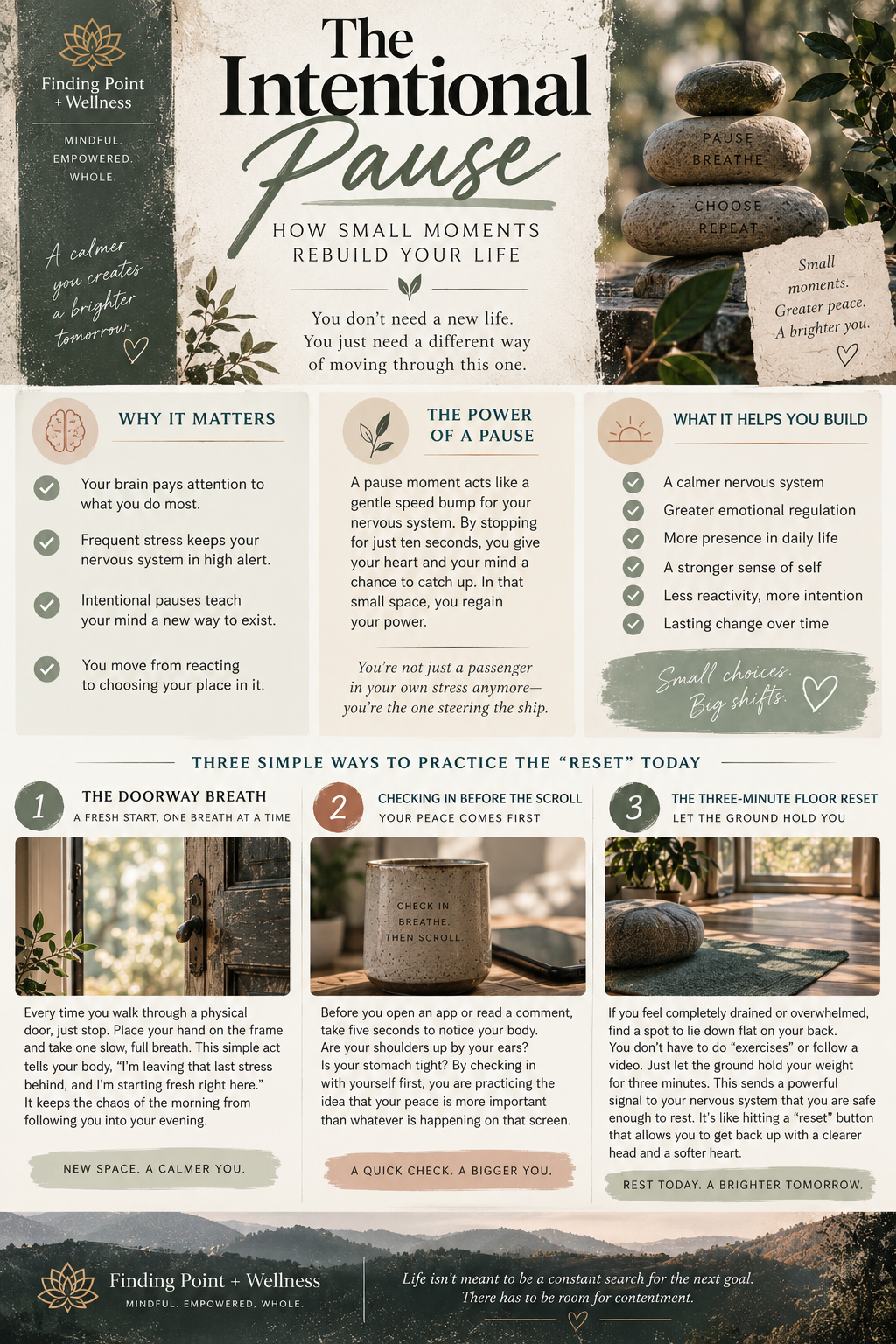
You don’t need to change your whole life to start feeling better. You just need to change how you move through it. Here are three simple ways to build a "calmer brain" right where you are:
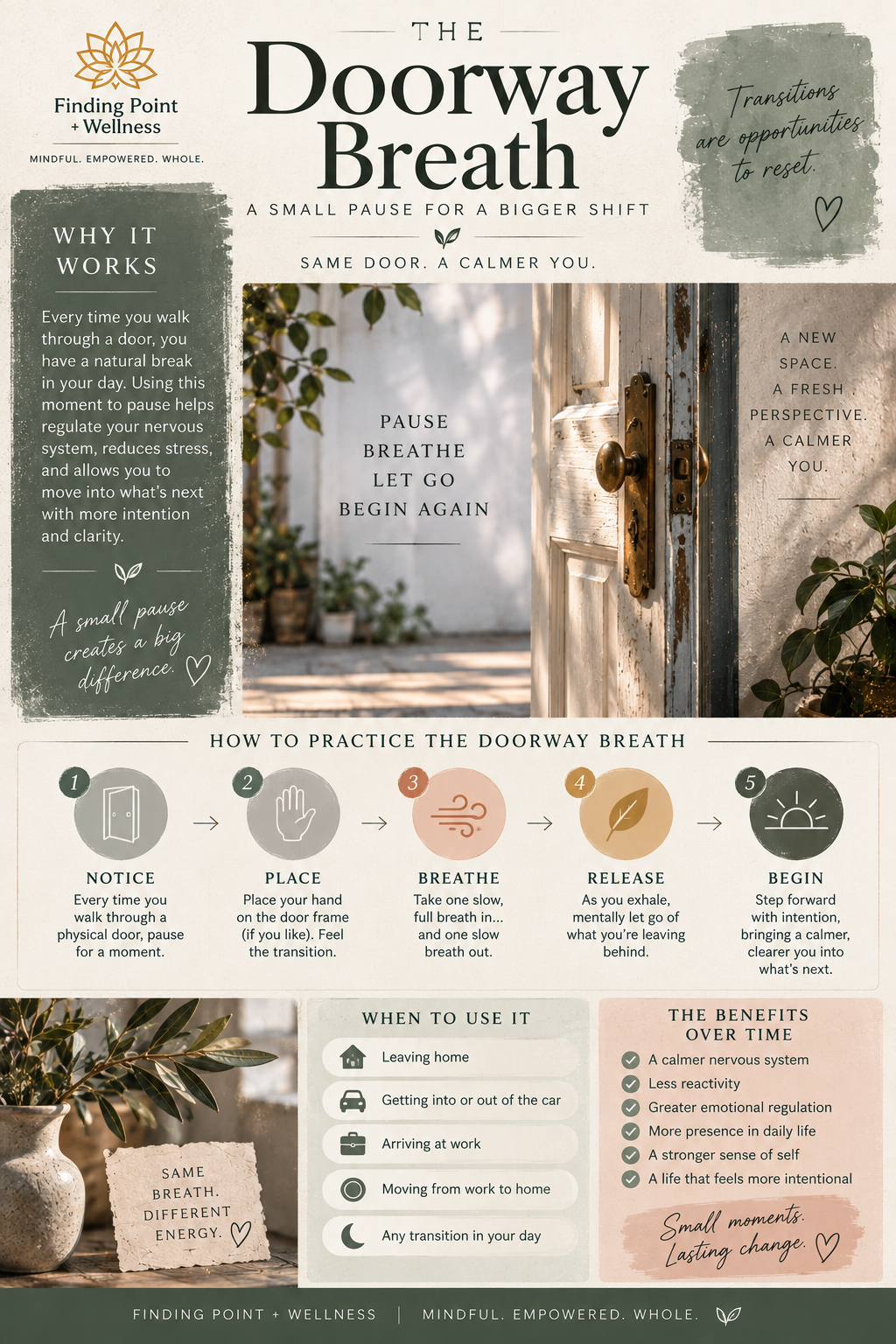
The Doorway Breath: We are always moving from one thing to the next—from the house to the car, or from work to the kitchen. Every time you walk through a physical door, just stop. Place your hand on the frame and take one slow, full breath. This simple act tells your body, "I’m leaving that last stress behind, and I’m starting fresh right here." It keeps the chaos of the morning from following you into your evening.
Checking in Before the Scroll: Most of us check our phones dozens of times a day, usually while we’re already tense or distracted. Before you open an app or read a comment, take five seconds to notice your body. Are your shoulders up by your ears? Is your stomach tight? By checking in with yourself first, you are practicing the idea that your peace is more important than whatever is happening on that screen.
The Three-Minute Floor Reset: Sometimes the best way to move forward is to stop moving entirely. If you feel completely drained or overwhelmed, find a spot to lie down flat on your back. You don’t have to do "exercises" or follow a video. Just let the ground hold your weight for three minutes. This sends a powerful signal to your nervous system that you are safe enough to rest. It’s like hitting a "reset" button that allows you to get back up with a clearer head and a softer heart. (This one is a favorite of mine and also helps my middle-aged body reset).
A Simple Four-Step Pause Practice
When you feel rushed, scattered, or emotionally flooded, try this short practice. Think of it as a friendly check-in rather than another item on your to-do list.
1. Stop. Let your hands become still for a moment. If you are walking, slow down. If you are typing, lift your fingers from the keyboard.
2. Feel. Notice one physical sensation without trying to fix it. Maybe your jaw is tight, your chest feels heavy, or your feet feel steady against the floor.
3. Breathe. Take one comfortable breath. There is no need to force it or make it impressive. Let the exhale be a little softer than the inhale.
4. Choose. Ask yourself, “What is the kindest useful next step?” The answer may be to continue, ask for help, drink water, set a boundary, or wait before responding.
The entire intentional pause practice can take less than a minute. What matters is not the length of the pause but the fact that you returned to yourself before moving forward.
When Pausing Feels Hard
At first, pausing can feel surprisingly uncomfortable. If your nervous system is used to constant motion, stillness may feel unproductive or even unsafe. You may forget all day and remember only when your head hits the pillow. That does not mean you are doing it wrong. It means you are learning a new pattern.
Start by attaching the pause to something you already do. Take one breath when you wash your hands. Relax your shoulders when a red light stops you. Put both feet on the ground before joining a meeting. These ordinary cues make the habit easier to remember because you are not trying to create extra time; you are using time that already exists.
Some days, the pause will create a noticeable shift. Other days, you may still feel irritated, exhausted, or overwhelmed afterward. The purpose is not to erase every uncomfortable feeling. The purpose is to respond to yourself with presence instead of abandonment. Even noticing, “This is a hard moment,” can be a meaningful form of self-care.
Finding Your Point: From Constant Seeking to Contentment
Life isn't meant to be a constant search for the next goal or the next fix. There has to be room for contentment—the quiet feeling that, right now, in this moment, you are enough. For myself, I spent so long trying to be who I thought I was “supposed to be”, I made myself miserable and forgot about who I am and what is truly important to me.
In a world that wants you to keep "seeking," choosing to stop is a quiet act of courage. It’s the period at the end of the sentence that lets you finally rest and breathe. Every time you choose a pause, you are building a life that feels more like a sanctuary and less like a race. That pause is so much more than “just a pause”.
Frequently Asked Questions About Intentional Pauses
How long should an intentional pause be?
A useful pause can last one breath, thirty seconds, or several minutes. Choose a length that fits the moment. Consistency is more important than duration.
Is an intentional pause the same as meditation?
They can overlap, but they are not exactly the same. Meditation is often a dedicated practice. An intentional pause is more portable: it can be woven into conversations, transitions, errands, and workdays.
What if I cannot calm down?
You do not have to become calm for the pause to count. Simply noticing your experience without adding judgment can interrupt the feeling that you must solve everything immediately. If stress feels persistent or unmanageable, reaching out to a qualified professional can be a caring next step.
How often should I practice?
Begin with one reliable cue each day. Once it feels natural, add another. A few genuine pauses spread throughout the day are more sustainable than an ambitious routine you dread.
I honestly believe that true vitality begins when we care for ourselves on a deeper level—not only when life is peaceful, but right in the middle of its noise. You do not need to overhaul your schedule today. Choose one doorway, one red light, or one moment before you reach for your phone. Let that ordinary moment become your reminder to stop, feel, breathe, and choose. A pause may look small from the outside, but inside it you are practicing trust, clarity, and a more compassionate way of living. One intentional pause will not solve everything. But it can change the next minute, and the next minute is where your life is actually happening.
