What are SMART Goals? How To Use Them in Your Life
There have been times in my life when the word “goal” felt more like pressure than possibility. Maybe you have felt that too. We hear about becoming more disciplined, more focused, more productive, more consistent, and sometimes it can begin to sound as if our worth depends on how well we perform. When life is already full, when our nervous system feels tired, when we are carrying grief, stress, uncertainty, or old patterns we are still trying to understand, goal setting can feel like one more place to disappoint ourselves.
But SMART goals do not have to be harsh. They do not have to be another measuring stick we use against ourselves. When I think about SMART goals through the lens of emotional health, I think about giving ourselves a kinder kind of structure. A structure that helps us see where we are, name where we would like to go, and take small steps that honor both our hopes and our humanness. In that way, SMART goals can become less about forcing ourselves forward and more about gently learning how to support ourselves as we grow.
The American Psychological Association describes goal setting as a process that includes specific, time-based, measurable, achievable, and realistic behavior targets. That definition gives us a helpful frame, but I also think we need to remember the person inside the process. We are not machines trying to complete an assignment. We are living, feeling people trying to move through real lives with real obstacles, histories, needs, bodies, relationships, and emotions.
What Are SMART Goals?
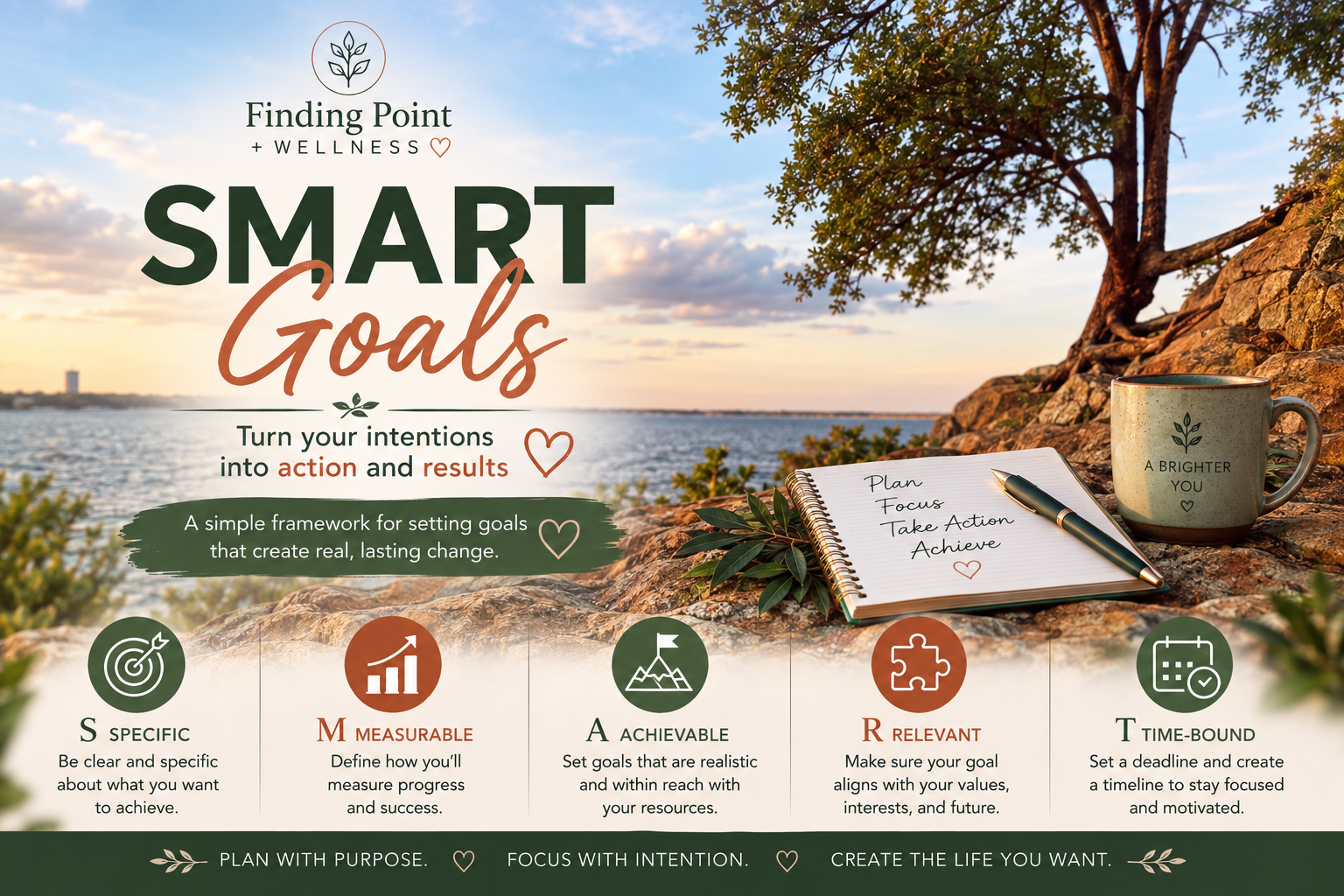
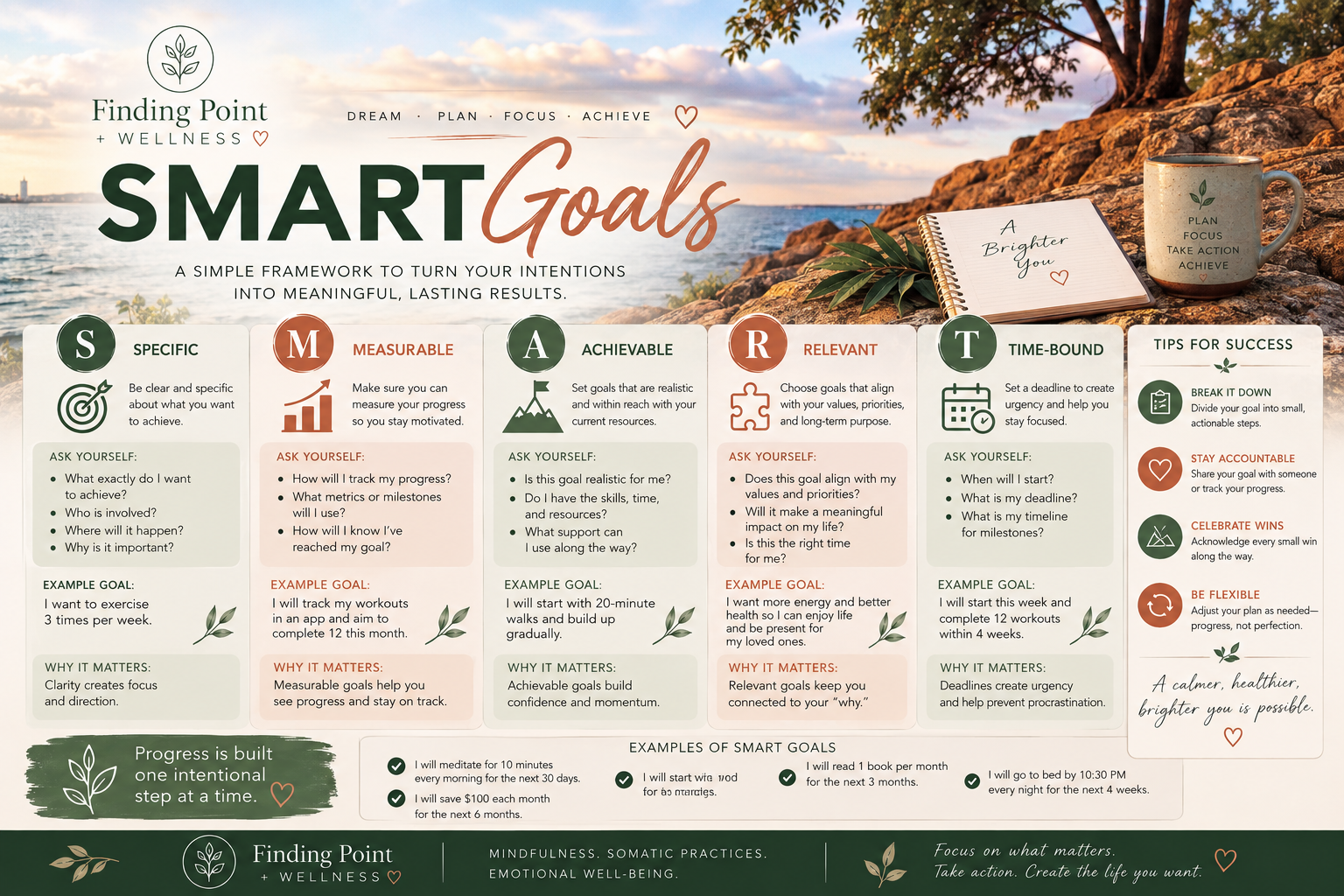
SMART goals are goals that are Specific, Measurable, Achievable, Relevant, and Time-bound. In everyday language, that means we are taking something that may feel vague or overwhelming and giving it a shape we can actually work with. Instead of saying, “I need to take better care of myself,” we might say, “For the next two weeks, I will take a ten-minute walk after lunch three days a week.” The second goal does not make us a better person. It simply gives our mind and body a clearer path to follow.
I like to think of SMART goals as a way of translating longing into practice. Sometimes we long for peace, steadiness, connection, health, creativity, or confidence, but we do not know where to begin. A SMART goal does not answer every question or remove every barrier, but it can help us find the next honest step. For readers who are exploring a fuller life through emotional well-being, mindfulness, body awareness, or gentle lifestyle practices, this kind of structure can become a bridge between what we feel inside and what we are learning to practice in daily life.
The Five Aspects of A SMART Goal
Why Goals Can Feel So Hard Sometimes
If goal setting were only about wanting something badly enough, most of us would have changed everything already. We would have the routines, the boundaries, the sleep, the nourishing meals, the movement, the calmer communication, the clearer sense of self. But change is rarely that simple. Sometimes we do want something deeply, and still we find ourselves stuck in the same familiar places.
That does not mean we are lazy or broken. It may mean our brains are trying to protect what feels familiar. It may mean our nervous systems are tired. It may mean the goal is too large, too vague, too disconnected from our real life, or quietly tied to shame. I have noticed that when a goal comes from self-criticism, it often becomes brittle. We may start strong, but the moment we miss a day, we collapse into all-or-nothing thinking. We tell ourselves we failed, and then we stop trying.
This is why I believe SMART goals work best when they are rooted in compassion. A goal created from shame says, “I need to fix myself.” A goal created from care says, “I am learning how to support myself.” Those two starting places feel very different in the body. One tightens. The other gives us a little room to breathe.
The Psychology Behind SMART Goals
Psychologically, our minds tend to do better when a task feels clear enough to begin. When goals are vague, we may spend more energy deciding what to do than actually doing it. “Be healthier” is a beautiful desire, but it can also feel too big. Does that mean changing food, sleep, stress, relationships, movement, water, screen time, or all of it at once? Our minds can become overwhelmed before we ever take the first step.
The National Institute of Mental Health reminds us that even small acts of self-care can support mental health, including movement, sleep, nourishing meals, relaxing activities, social connection, and setting priorities. That matters because SMART goals do not have to be dramatic to be meaningful. Sometimes the most healing goal is not the one that looks impressive from the outside. Sometimes it is the one that helps us keep a promise to ourselves in a way our body can actually receive.
The Greater Good Science Center also speaks often about practices that support social and emotional well-being. I appreciate that language because it reminds me that goals are not only about achievement. They can also be about becoming more connected, more grounded, more compassionate, and more present in the life we already have.
Making SMART Goals Feel Gentle Instead of Demanding
To make SMART goals gentle, I begin by asking a different kind of question. Not “What is wrong with me that needs to be fixed?” but “What part of my life is asking for care right now?” That question changes the energy of the goal. It helps us listen inward rather than perform outward.
If I notice I am emotionally worn down, my SMART goal might not be to overhaul my whole life. It might be, “For the next seven days, I will spend five quiet minutes in the morning noticing my breath before I look at my phone.” That is specific. I know what I am doing. It is measurable. I can tell whether I did it. It is achievable. Five minutes feels possible. It is relevant because I am trying to begin the day with more steadiness. It is time-bound because I am practicing it for one week, not forever.
This is also where mindfulness can become part of the process. A goal is not only something we complete. It is something we notice ourselves moving through. What comes up when we try? Resistance? Grief? Fear of failure? A desire to quit before we can be disappointed? These moments are not interruptions to the goal. They are part of what the goal is teaching us.
Example: Bringing SMART Goals Into Action
Examples of SMART Goals for Real Life
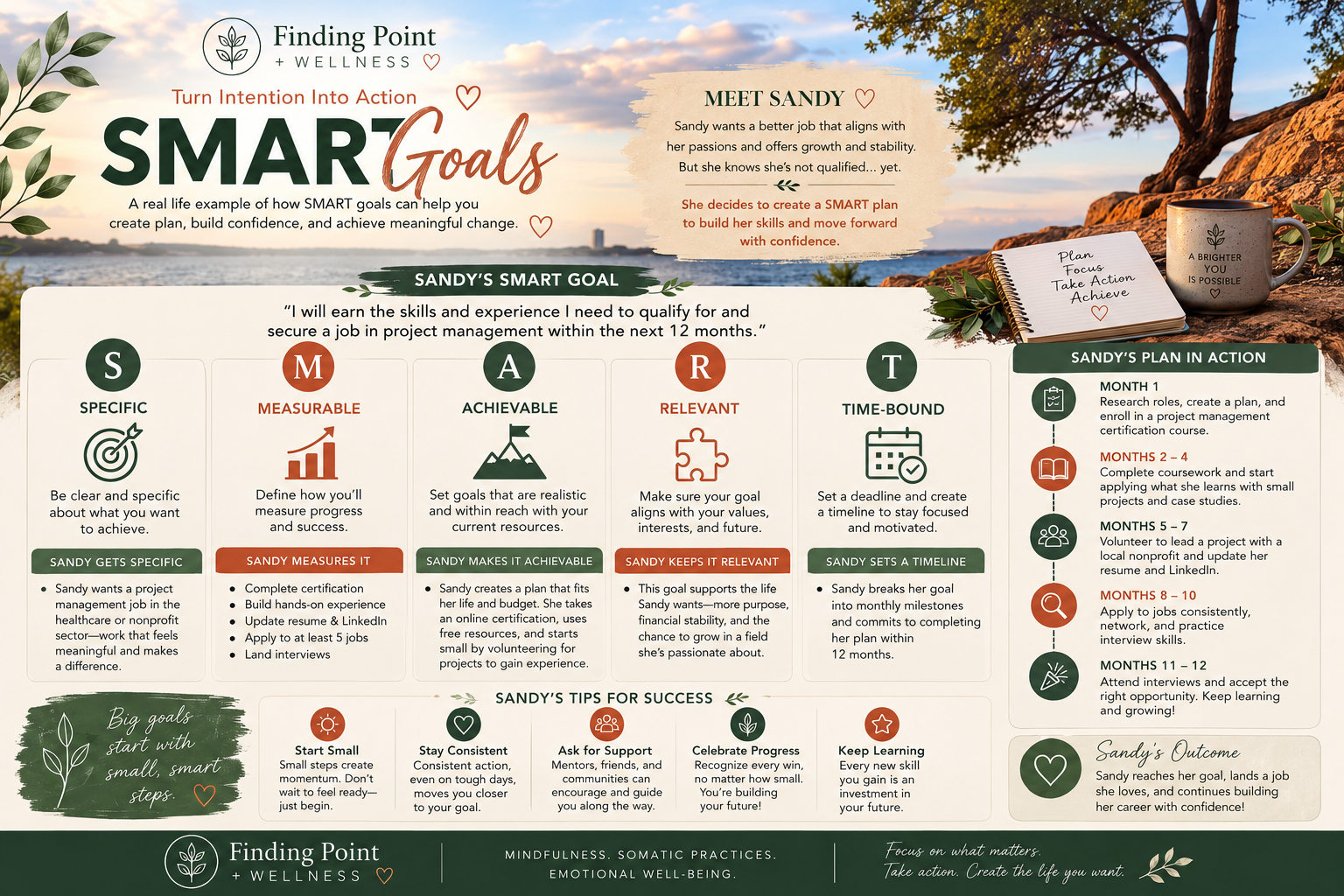
Let’s imagine someone wants to feel less overwhelmed in the evenings. A vague goal might be, “I need to manage my stress better.” A gentle SMART goal might be, “For the next two weeks, I will set a ten-minute transition time after work where I sit quietly, drink water, and take a few slow breaths before starting dinner or household tasks.” That goal recognizes that stress is not only a thought problem. It lives in the body too. It gives the nervous system a small doorway into rest.
Or maybe someone wants to build healthier boundaries in a relationship. A vague goal might be, “I need to stop saying yes all the time.” A SMART goal might be, “This week, before I agree to any new request, I will pause and say, ‘Let me think about that and get back to you.’” That may sound small, but for someone who has spent years pleasing others to feel safe, that pause can be a brave new skill.
Maybe the goal is connected to movement and physical wellness. Instead of saying, “I have to work out every day,” we might say, “On Monday, Wednesday, and Friday, I will walk for fifteen minutes after breakfast for the next month.” This kind of goal allows movement to become a relationship with the body rather than a punishment for having a body. We can ask, “How do I feel before I walk? How do I feel after? What does my body seem to appreciate?”
Nutrition goals can be held gently too. Instead of demanding perfection, we might choose, “For the next ten days, I will add one nourishing food to my lunch, such as fruit, vegetables, beans, or a protein I enjoy.” This gives us a way to move toward care without turning food into fear. For many of us, sustainable change begins when we stop treating ourselves like a problem and start treating ourselves like someone worth tending to.
Working Through the Problems That Come Up
One of the most important things I have learned is that obstacles are not always signs that a goal is wrong. Sometimes they are invitations to understand ourselves more honestly. If I miss a goal for three days, I can shame myself, or I can get curious. Was the goal too big? Was the timing unrealistic? Did I need support? Did a part of me feel afraid of succeeding? Did I secretly choose a goal because I thought I should, not because it truly mattered to me?
This is where we can practice emotional honesty. If the goal was to journal every night, but nighttime is when we are exhausted, maybe the problem is not commitment. Maybe the problem is timing. We could adjust the goal to three mornings a week or voice-record a short reflection instead. If the goal was to walk after work, but the weather, caregiving, or fatigue keeps getting in the way, maybe we choose indoor stretching or a five-minute somatic reset. Adjusting is not failing. Adjusting is listening.
When we experience setbacks, it may help to remember that behavior change often works better with practical “if-then” plans. For example, “If I miss my morning walk, then I will take five minutes to stretch before bed.” This gives our mind a backup path instead of a dead end. It also keeps us from turning one missed step into proof that we cannot change.
Learning the Skill of Returning
I sometimes think the real skill inside SMART goals is not discipline. It is returning. Can we return without attacking ourselves? Can we return after a hard week, a messy conversation, a tired season, a day when our body said no, or a moment when old patterns took over? Can we come back to the goal with tenderness instead of punishment?
Returning might sound like, “I did not practice yesterday, and I can begin again today.” It might sound like, “This goal needs to be smaller.” It might sound like, “I need help.” It might sound like, “This no longer fits who I am becoming.” There is wisdom in that. A goal is not a cage. It is a tool. If the tool stops helping, we are allowed to reshape it.
Personal reflections can help us notice the deeper story beneath our goals. We might ask, “What am I hoping this goal will help me feel?” Safe? Proud? Connected? Less scattered? More present? More at home in myself? When we understand the emotional need underneath the goal, we can work with ourselves more kindly. We stop chasing an outcome and begin caring for the inner experience that led us there.
A Gentle Practice for Creating Your Own SMART Goal
If you would like to try this today, you might begin by choosing one area of life that feels tender but workable. Not the whole mountain. Just one small place. Maybe emotional well-being, relationships, rest, nourishment, movement, mindfulness, or nervous system care. Then ask yourself, “What would support look like here in a way I can actually practice?”
From there, shape the goal gently. Make it specific enough that you know what to do. Make it measurable enough that you can notice progress without obsessing over it. Make it achievable enough that your body does not immediately brace. Make it relevant to something that truly matters to you. Give it a time frame that feels like a practice window rather than a life sentence.
For example: “For the next seven days, I will spend five minutes before bed writing down one thing I felt, one thing I needed, and one small way I cared for myself.” This is not dramatic. It will not solve everything. But it can help us build self-awareness, and sometimes self-awareness is the beginning of change.
Moving Forward With a Softer Kind of Structure
SMART goals, when held gently, can help us move toward change without losing compassion for the parts of us that are still learning. They can help us turn vague hopes into small practices. They can help us notice what supports us, what overwhelms us, and what needs to be adjusted along the way. They can remind us that growth is not always a straight line and that returning is part of the work.
Maybe today we do not need to change our whole life. Maybe we only need to choose one honest place to begin. One small step. One supportive rhythm. One promise that feels kind enough to keep. And if we stumble, we can pause, breathe, listen, and begin again—not because we failed, but because we are still here, still learning, and still worthy of being cared for as we grow.
