What is Nonviolent Communication (NVC)? A Guide to Better Communication
There have been seasons in my life when I thought communication meant finding the right words quickly enough to keep a situation from falling apart. I thought if I could explain myself better, soften my tone enough, stay quiet long enough, or say the thing perfectly, maybe there would be less tension. Maybe I would feel safer. Maybe the other person would finally understand what I was trying to say.
But over time, I began to realize that communication is not just about words. It is also about what is happening inside our bodies, our nervous systems, our memories, our needs, and our fear of being misunderstood. This is one reason nonviolent communication can feel so meaningful. It gives us a gentle way to slow down, notice what is really happening, and speak from a more honest place without using blame, shame, or harshness.
Nonviolent communication is often associated with the work of Marshall Rosenberg and the Center for Nonviolent Communication, but at its heart, it is not about sounding polished or emotionally advanced. It is about learning how to listen for feelings and needs—both our own and someone else’s—especially when conversations become tender, messy, or difficult.
Why Nonviolent Communication Matters in Everyday Life
Most of us do not wake up wanting to hurt people with our words. We usually react because something inside us feels threatened, dismissed, unseen, rushed, or overwhelmed. I have noticed that when we feel emotionally cornered, we may defend, explain, withdraw, criticize, people-please, or become louder than we intended. Not because we are bad people, but because our system is trying to protect us.
The American Psychological Association notes that open, kind communication and listening to another person’s point of view can support healthier relationships, especially during disagreement. That feels important to name, because hard conversations are not a sign that a relationship is failing. Sometimes they are simply places where something underneath the surface is asking for attention.
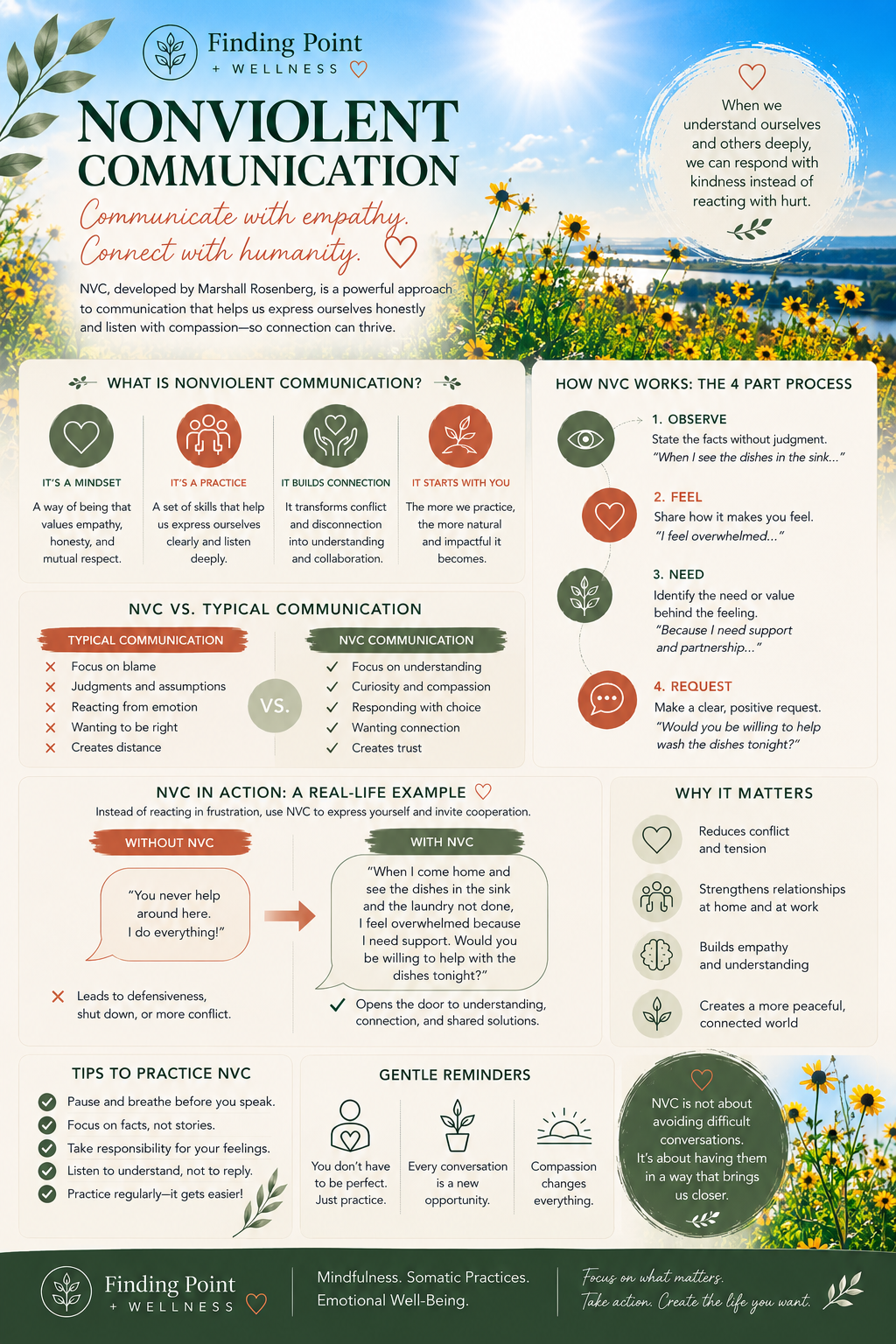
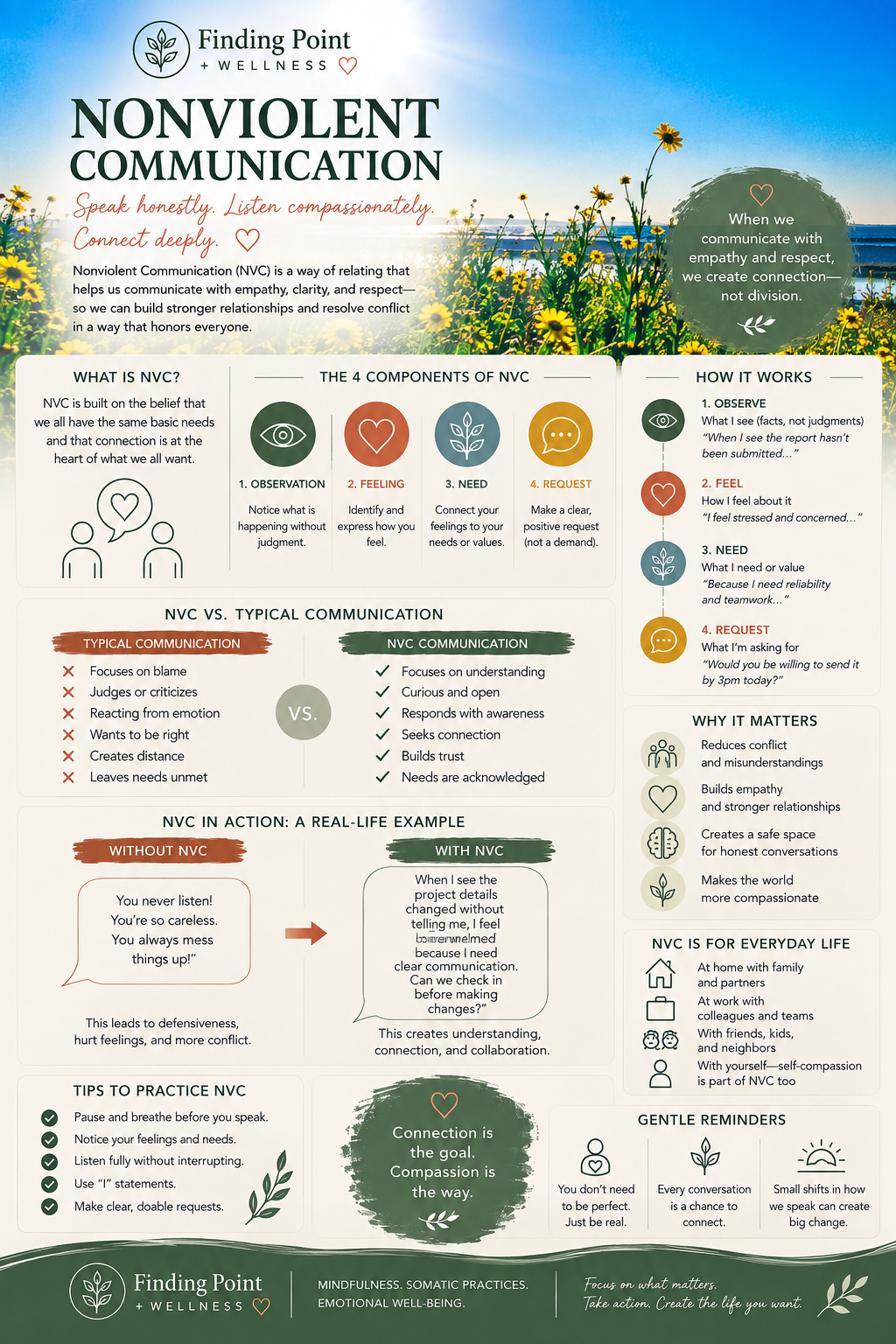
When I think about nonviolent communication, I think about the difference between saying, “You never listen to me,” and saying, “I notice I feel lonely and discouraged when I am talking and I do not feel heard. I think I may need more presence and reassurance right now.” The second version does not guarantee the other person will respond well. But it gives the conversation a softer doorway. It helps us speak from our inner experience instead of leading with accusation.
For readers who are already exploring emotional healing, mindfulness, or healthy boundaries, this approach fits naturally with many of the practices we talk about at Finding Point. Internal link opportunities might include phrases such as emotional well-being, mindfulness, healthy boundaries, relationships, somatic practices, movement and physical wellness, nutrition, and personal reflections, using updated Finding Point URLs where those articles are available.
What Is Nonviolent Communication?
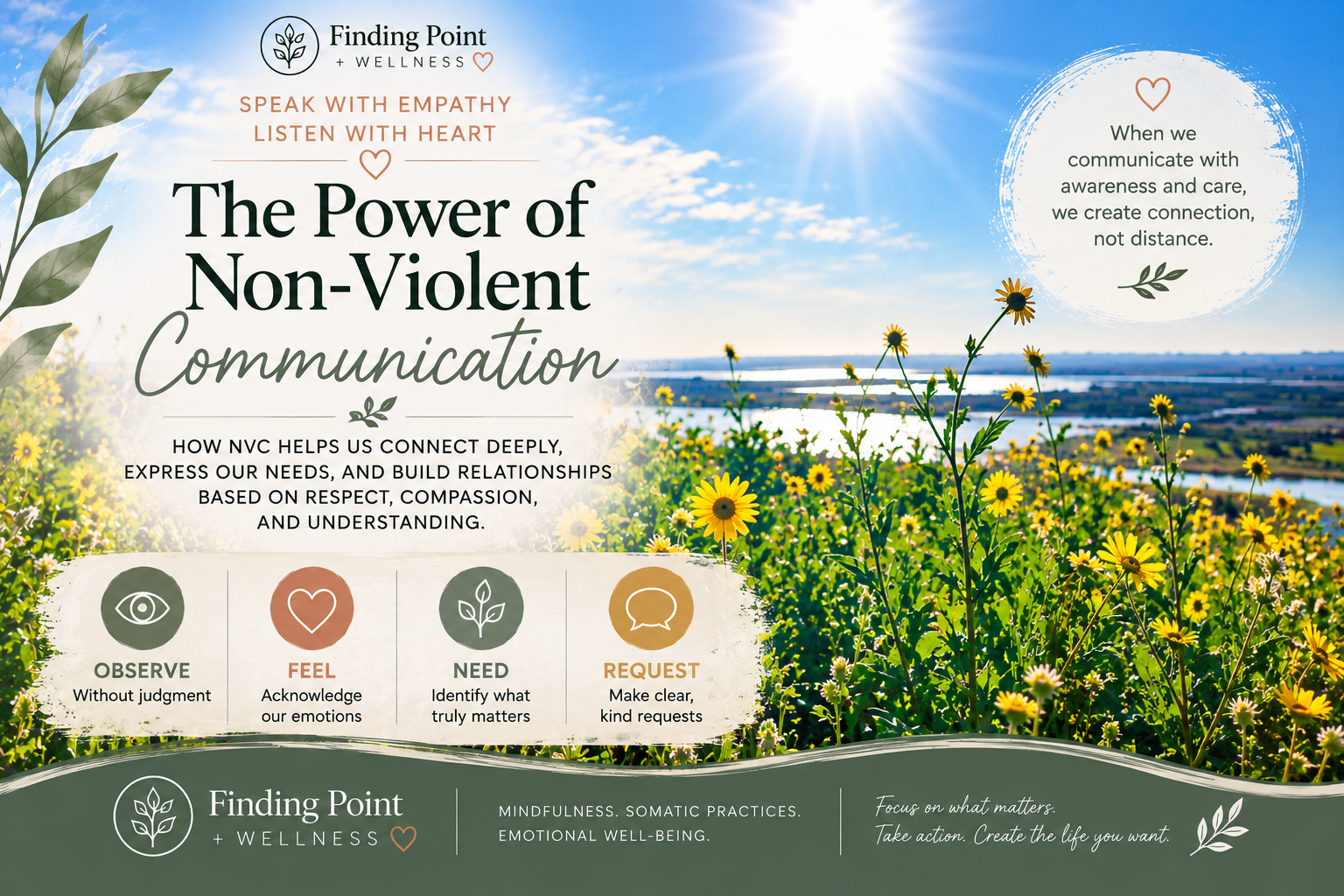
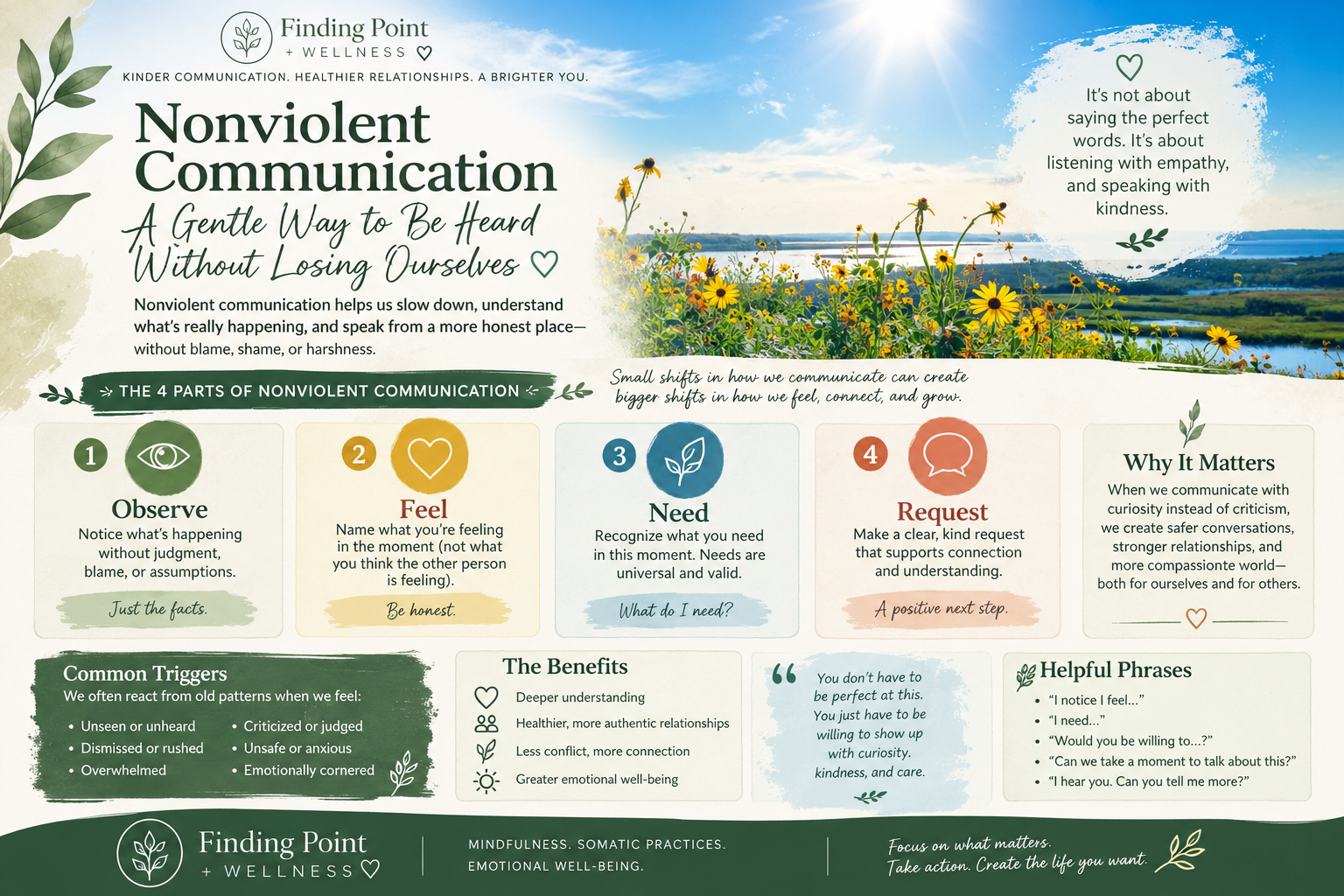
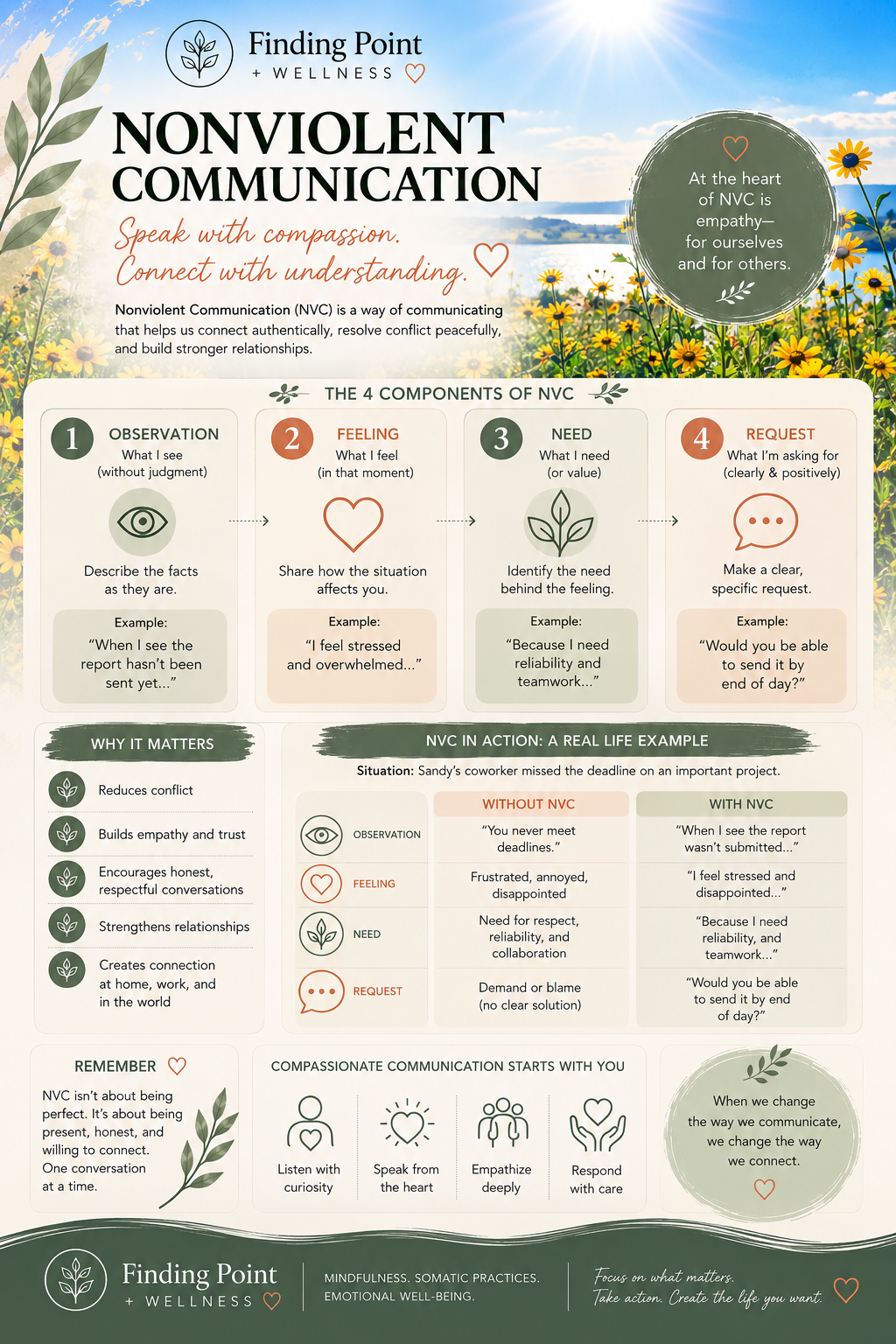
In simple terms, nonviolent communication is a way of communicating that helps us move from blame into self-awareness, curiosity, and connection. It usually includes four gentle parts: noticing what happened, naming what we feel, recognizing what we need, and making a clear request.
That may sound simple, but simple does not always mean easy. If we grew up in environments where emotions were dismissed, conflict felt unsafe, or needs were treated like inconvenience, naming what we feel and need can feel unfamiliar. Some of us learned to scan the room before we knew how to check in with ourselves. Some of us learned that being agreeable kept peace. Some of us learned that speaking up created more pain than staying quiet.
This is why nonviolent communication is not only a relationship skill. It is also an emotional health practice. It invites us to pause long enough to ask, “What is actually happening inside me right now?” That question alone can change the direction of a conversation.
Why We React Before We Understand
When a conversation becomes tense, many of us move into old patterns before we even realize it. A partner’s tone, a friend’s silence, a coworker’s criticism, or a family member’s disappointment can touch something deeper than the moment itself. Suddenly, we may not be responding only to what was said. We may also be responding to years of not feeling chosen, believed, respected, protected, or emotionally safe.
Psychologically, this makes sense. Our minds and bodies are always trying to make meaning from what happens around us. If a certain kind of conversation has felt painful in the past, our system may react quickly in the present. We might hear rejection where there is only confusion. We might feel abandoned when someone is simply tired. We might become defensive when what we really feel is embarrassed or afraid.
The National Institutes of Health describes emotional wellness as the ability to handle life’s stresses and adapt to change and difficult times. That does not mean we never get upset. It means we slowly learn how to come back to ourselves with more steadiness. Nonviolent communication can be one of those steadying practices because it helps us sort through the swirl before we speak from it.
The Four Gentle Steps of Nonviolent Communication
The first step is observation. This means naming what happened without adding a harsh story to it. Instead of “You ignored me all night,” we might say, “When I shared something earlier and the conversation moved on quickly, I noticed I felt hurt.” Observation helps us separate the moment from the meaning we placed on it.
The second step is feelings. This is where we gently name our inner experience. Maybe we feel sad, overwhelmed, embarrassed, tender, unsettled, lonely, disappointed, or unsure. Feelings are not accusations. They are signals. They tell us something matters.
The third step is needs. Under every strong feeling, there is often a human need. We may need rest, respect, clarity, tenderness, space, belonging, consistency, honesty, support, or reassurance. Naming a need can feel vulnerable because it brings us closer to the truth. But it also gives the other person something real to respond to.
The fourth step is a request. A request is different from a demand. It gives the other person a clear place to meet us, while still respecting their humanity. We might say, “Would you be willing to pause and let me finish my thought?” or “Could we talk about this after dinner when we both have more energy?”
A Real-Life Example: When We Feel Unheard
Imagine we are telling someone about a hard day, and they immediately try to fix it. They say, “Well, just don’t worry about it,” or “You should do this instead.” Maybe they are trying to help. But inside, we may feel dismissed. The old version of us might snap, “You never understand me.” Or we might shut down and decide not to share next time.
With nonviolent communication, we might try something softer: “When I tell you about my day and hear advice right away, I notice I feel a little alone. I think I am needing comfort before solutions. Would you be willing to listen for a few minutes before helping me problem-solve?”
That kind of sentence may feel awkward at first. We may stumble through it. We may have to pause and start again. That is okay. We are not trying to become perfect communicators. We are learning to become more present communicators.
Listening Without Losing Ourselves
Nonviolent communication is not only about how we speak. It is also about how we listen. Listening with compassion does not mean agreeing with everything someone says. It does not mean abandoning our boundaries or taking responsibility for another person’s emotions. It means we practice hearing the feeling or need underneath their words, when it is safe and healthy for us to do so.
The Greater Good Science Center describes empathy as sensing another person’s emotions and imagining what they may be thinking or feeling. In everyday life, this might sound like, “I can hear that you felt left out,” or “It sounds like you were hoping I would check in sooner.” Sometimes that one moment of being understood can soften a conversation more than a long explanation ever could.
Still, I want to be careful here. Empathy is not the same as self-erasure. If a conversation includes repeated disrespect, intimidation, manipulation, or emotional harm, nonviolent communication does not require us to stay engaged. Gentle communication and healthy boundaries belong together. Sometimes the most caring response is, “I want to talk about this, but I am not able to continue while we are speaking to each other this way.”
Practicing Nonviolent Communication in the Body
Before we can speak gently, many of us need to feel safe enough inside ourselves to slow down. That is where somatic awareness can help. We might notice our shoulders rising, our jaw tightening, our stomach turning, or our breath becoming shallow. These are not problems to criticize. They are information.
One simple practice is to pause before responding and silently ask, “What am I feeling? What am I needing? What might the other person be feeling or needing?” Even ten seconds can create a little more space between the trigger and the response. If ten seconds feels impossible, we can try one slow breath. If one slow breath feels like too much, we can place our feet on the floor and notice the support beneath us.
These small moments matter. We do not have to wait until we are calm, healed, rested, and perfectly wise to practice. We can begin in ordinary moments: before sending a text, before answering a defensive email, before correcting a child, before responding to a partner, or before agreeing to something our body is quietly saying no to.
Gentle Phrases We Can Practice Today
If nonviolent communication feels new, it can help to have a few phrases nearby until the language becomes more natural. We might try, “I may be misunderstanding, but this is how I heard it.” We might say, “I am feeling a little tender, and I want to respond thoughtfully.” Or, “Can we slow this down? I want to understand, and I also want to explain myself clearly.”
In a relationship, we might say, “When plans change last minute, I feel unsettled because I value predictability. Could we talk about changes as early as possible?” At work, we might say, “When I receive a request at the end of the day, I feel pressure because I want to do good work and also protect my energy. Can we decide what truly needs to happen today?” With ourselves, we might say, “I notice I am judging myself for being upset. I think I need kindness and a little time to understand what this feeling is trying to tell me.”
These examples are not scripts we must memorize. They are starting places. The deeper practice is learning to pause, soften, and ask what is true without making ourselves or someone else the enemy.
When Nonviolent Communication Feels Difficult
There may be times when we try to communicate gently and still feel misunderstood. This can be discouraging. We may wonder, “What is the point of doing all this inner work if the other person still does not meet me with care?” That question deserves tenderness.
Nonviolent communication is not a magic formula that makes every conversation safe or every relationship mutual. It cannot force someone else to listen, reflect, repair, or grow. What it can do is help us remain more connected to ourselves. It can help us speak with more clarity. It can help us notice when a conversation is possible and when we may need distance, support, or a firmer boundary.
It is also okay if this practice brings up grief. When we begin naming our needs, we may realize how long we have gone without feeling safe to have them. We may notice how often we have translated pain into politeness, exhaustion into responsibility, or fear into over-explaining. That noticing can be tender, but it can also be the beginning of a more honest relationship with ourselves.
How We Begin Responding Differently
We begin by practicing in low-pressure moments. Maybe we start with a journal entry: “When this happened, I felt… because I needed…” Maybe we practice with a trusted friend. Maybe we write the text but wait before sending it. Maybe we notice the difference between a feeling and a story: “I feel anxious” is different from “They do not care about me.” Both may be present, but they are not the same.
We can also practice repair. Repair might sound like, “I realize I came in sharper than I wanted to. I was feeling overwhelmed, but I do not want to speak to you that way.” Repair is not self-blame. It is a bridge back to connection when we have drifted away from the kind of person we want to be in conversation.
Over time, these practices can support more grounded relationships—with partners, friends, children, coworkers, and ourselves. They may also support our larger emotional well-being because we are no longer leaving so much unsaid inside our own bodies.
A Gentle Invitation to Practice
Nonviolent communication asks us to believe that underneath many painful conversations are human beings trying, in imperfect ways, to protect something tender. It asks us to slow down enough to notice what we feel, what we need, and how we might speak without making ourselves or someone else wrong for being human.
I do not think this work is about becoming calm all the time. I think it is about becoming more honest, more compassionate, and more able to stay near ourselves when conversations get hard. Maybe today we begin with one pause, one softer sentence, one moment of listening, or one small request spoken with care. And maybe, little by little, we learn that being heard does not have to begin with force. Sometimes it begins with gentleness, curiosity, and the quiet willingness to meet ourselves where we are.
